Issue 44 · Field Notes
The Keeper of the Ninth Meridian
For thirty-one winters, Ada Rennick logged the weather at Fenmoor Light in a hand so small it had to be read with a lens. Then the automation crew arrived.
Section IArrival at Fenmoor
The boat that carries you to Fenmoor is not a boat so much as an argument with the sea, conducted at eleven knots and settled, usually, in the sea's favour. It leaves the mainland at Cobb's Quay on Tuesdays and Fridays, weather permitting, and the phrase weather permitting is doing an enormous amount of work in that sentence.1In the winter of 2019 the crossing ran four times in eleven weeks. Rennick recorded the gap in her log as “nothing but water.” In the eleven years I have been visiting the island I have been turned back at the quay nine times and turned back mid-crossing twice, which is a different and more educational experience.
Ada Rennick met me at the landing in a coat that had outlived two governments. She is seventy-four. She has the particular stillness of people who have spent decades watching a horizon for a living, a stillness that reads at first as coldness and later, once you understand it, as a form of attention so complete it has stopped bothering with the face.
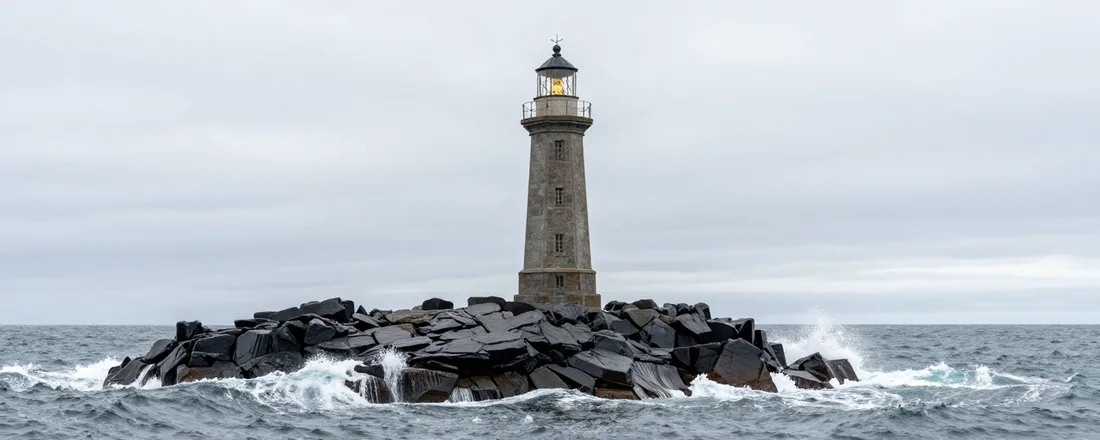
“You're late,” she said, which was true by two days and entirely the sea's fault, and then she took my bag without being asked and walked ahead of me up the shingle. The light itself stands ninety metres above the tideline on a plug of grey basalt.2Fenmoor Light: first lit 1863, tower height 34 m, focal plane 121 m, character Fl(2) W 15s. The lens is a first-order Fresnel, one of nine still turning on this coast. The tower is painted in bands, white over ox-blood red, and the paint is renewed every fourth spring by a contractor who arrives with scaffolding and complaints in equal measure.
Section IIWhat the Log Contains
Every keeper keeps a log, and every log is officially a weather record and unofficially something else. The official columns are prescribed: hour, barometric pressure, wind force and quarter, sea state, visibility, precipitation, and a narrow final column headed Remarks. It is the remarks column where the keepers live.3The column is 41 mm wide. Rennick's hand averages 1.6 mm x-height, which is roughly half the size of the type you are reading now.
Rennick's remarks are famous among the small population of people to whom lighthouse logs can be famous. They are not literary. They are, if anything, aggressively unliterary — but across thirty-one years they accumulate into something that behaves like a novel written by the weather.
Selected remarks, 1993–2024
- 1993“Gannets back. Earlier than the book says. Book is wrong.”04 Mar
- 1997“Fog for nine days. Have read everything twice.”21 Nov
- 2001“Supply boat lost a crate. Recovered: apples, one boot.”08 Jan
- 2006“Aurora, faint, green, north-north-east. Woke myself to look twice.”14 Feb
- 2013“Storm Ninian. Gallery glass gone. Lamp held.”02 Dec
- 2019“Nothing but water.”27 Feb
- 2024“Engineers arrived. Three of them. Polite.”11 Sep
“A light doesn't warn you about the rock. It warns you that somebody once thought you were worth warning.”
Ada Rennick, principal keeper, 1993–2024
The Northern Coastal Board began automating its stations in 1988 and finished, notionally, in 1998. Fenmoor was the exception, kept manned by a clause in the original endowment that nobody had the appetite to litigate.4The 1861 endowment of Thomas Fenmoor Rennick — no relation, she insists, though the parish registers are less certain — requires “a keeper resident and waking.” The clause held for twenty-six years, which is longer than most clauses manage.
Section IIIThe Drift of Instruments
Instruments drift. This is the first thing any keeper learns and the last thing any engineer believes. A barometer left alone for a decade will wander from truth by a millibar or two, gently, without ever announcing it, and the only defence is a human being who notices that the number and the sky disagree.5Rennick recalibrated the station aneroid against the mercury column every Sunday for thirty-one years. The automated package calibrates monthly, against itself.
The replacement system at Fenmoor is a grey box the size of a filing cabinet. It reports every six minutes over a satellite link, runs on a lithium bank charged by two arrays on the south face of the engine house, and has, by the board's own reckoning, a mean time between failures of eleven years. It cannot see the gannets. This is not a criticism; it was never asked to.
What the box does do, extremely well, is not sleep. In the last full year of manned operation the light was dark for a cumulative forty-one seconds, all of them during a bulb changeover in a gale. In the first year of automation it was dark for six seconds.6Board of Coastal Lights, Annual Availability Return 2025, table 6. Six seconds, during a scheduled failover test at 03:14 on a flat calm night in June. By every measure the board is required to publish, the machine is better.
The question was never whether the box could keep the light. It was what else a keeper had been keeping.
Section IVHandover
On the last morning we walked the gallery at first light, the two of us, ninety metres up in a wind that made conversation a formality. Rennick pointed out the Sister Stacks and the two dead bearings, the shoal that shows only at spring tides, and the place where a Belgian trawler went down in 1971 with all six aboard and the light burning perfectly the whole time.
“People think the job is the light,” she said. “The job is the log.” She had already boxed thirty-one years of them — sixty-two volumes, half-bound in dark blue cloth — for the county archive, where they will be scanned at 600 dpi and made searchable and, she suspects, read by no one.7The Fenmoor logs entered the county archive in March 2025 as collection NCB/FEN/1–62. Digitisation is scheduled for 2027, funding permitting.
The boat came at eleven. She locked the tower door, which does not need locking, and handed the key to a man from the board who did not know what to do with it and put it in his jacket pocket like a receipt. The light came on at 16:41 that afternoon, on schedule, flashing twice every fifteen seconds, exactly as it has since 1863 and exactly as it will for as long as the box keeps counting.
Nobody was there to write it down.
Notes & Sources
- Crossing statistics from Cobb's Quay Harbour Trust sailings register, 2014–2025. Trust archive.
- Tower dimensions per Board of Coastal Lights, List of Lights, Vol. II (North & West), 41st edn.
- Measurements taken from log volume 47 with the author's loupe, October 2024.
- Endowment text transcribed from the 1861 deed, Fenmoor parish chest, folio 12r.
- Calibration practice described in Rennick's own hand, log volume 3, front endpaper.
- Board of Coastal Lights, Annual Availability Return 2025, table 6.
- County Archive accession note NCB/FEN, 14 March 2025.
- Interviews conducted at Fenmoor Light and at Cobb's Quay between June 2024 and February 2025. Ms Rennick reviewed quotations for accuracy but not for content.