Coir fibre
Four parts. The skeleton of the mix — holds structure for years and refuses to compact under its own weight.
Vitrine Quarterly — Issue 12 — Sealed Systems
A field journal for people who build closed ecologies on windowsills. We read the vessel the way a geologist reads a cliff face: from the rim down, one seam at a time.
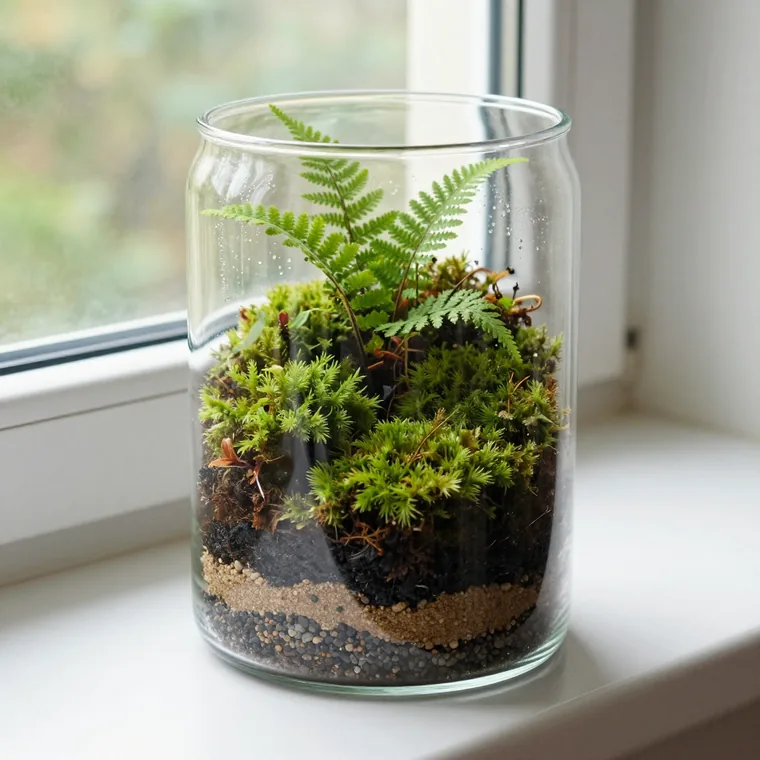
Layer 01 · 012 mm
Nothing here is decoration. The moss mat is the terrarium's lung and its clock — the first thing to tell you the humidity has slipped, weeks before a fern will admit it.
Day 61. Leucobryum tips pale to silver-grey by mid-afternoon and recover by dawn. Normal. Panic only if the recovery takes two nights.
Day 76. A single seta pushed up beside the driftwood. Sealed systems rarely reproduce this early; we credit the north window and total neglect.
Day 90. Population estimated at 400. They are the cleanup crew, the mould insurance, and the only livestock that will forgive you.
Day 115. Fog now clears from the glass by 10:00 daily. This is the signal that the vessel has finished arguing with itself.
Layer 02 · 038 mm
Twenty-six millimetres of substrate is the whole economy. Too rich and it sours; too lean and the ferns stall. Our house mix, weighed dry, in four parts.
Four parts. The skeleton of the mix — holds structure for years and refuses to compact under its own weight.
Three parts, beech preferred, two winters old. Slow nitrogen and a native fungal culture you cannot buy.
Two parts. Air pockets that survive watering. The difference between damp soil and drowned soil.
One part, no more. Enough to feed a sealed system for three years without inviting algae to the glass.
Layer 03 · 074 mm
A black seam two centimetres thick, doing the unglamorous work of adsorbing everything the soil above releases. Twelve vessels, measured at day 400.
| Vessel | Seam | Substrate | Clarity at d400 |
|---|---|---|---|
| Ash cloche | 22 mm | Coir / mould | 98% |
| Kilner No. 4 | 18 mm | Coir / pumice | 94% |
| Wardian box | 25 mm | Leaf mould | 96% |
| Demijohn | 8 mm | Peat-free | 71% |
| Bell jar (control) | 0 mm | Coir / mould | 44% |
Clarity measured as unobstructed glass area, photographed at 10:00 under identical north light.
Layer 04 · 096 mm
“A terrarium is not a garden. It is an argument between water and glass that you have agreed to referee for the rest of your life.”
Layer 05 · 124 mm
Thirty-six millimetres of washed grit — the void that decides whether the whole column survives a heavy hand with the watering can. Get letters from the layer below.