Green Sea TurtleChelonia mydas
Grazes seagrass meadows in water shallow enough to read a newspaper in. Surfaces every few minutes; navigates thousands of kilometres by magnetic inclination alone.
The Benthic Review · Field Register No. 12 · Descent Edition
A vertical field guide to the five pelagic zones — read it the way a submersible reads them, from the caustic shimmer of the surface to the crushing black of the hadal trenches. Scroll is descent. The gauge on your right is honest.
Begin descent ↓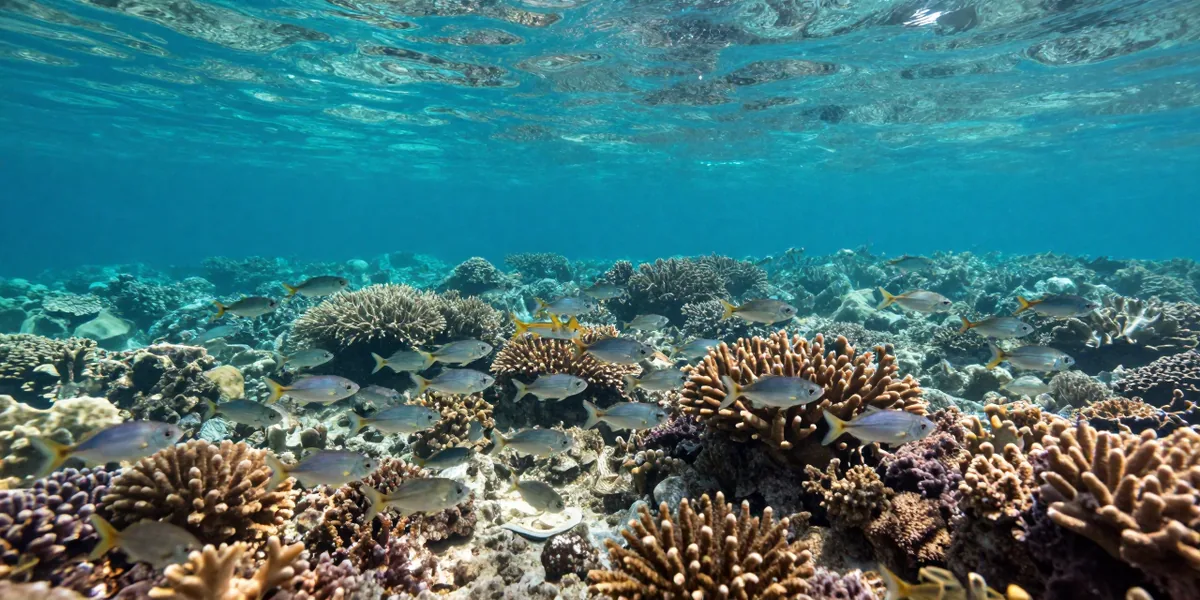
Zone 01 · 0–200 m
Epipelagic
Every photosynthetic thing in the ocean lives here. Ninety percent of marine life competes for a layer thinner than most mountains are tall.
| Pressure | 1 – 21 atm |
|---|---|
| Light | 100 – 1 % |
| Temp | 26 → 12 °C |
| Photosynthesis | Yes |
Grazes seagrass meadows in water shallow enough to read a newspaper in. Surfaces every few minutes; navigates thousands of kilometres by magnetic inclination alone.
A reef algae-grazer whose colour is structural, not pigmented — microscopic plates scatter blue light back at you. Schools tighten into a single flickering body when a jack passes.
Rests in the sunlit layer by day, then descends at dusk to hunt the rising scattering layer — one of the few animals that commutes between zone one and zone two nightly.
Zone 02 · 200–1,000 m
Mesopelagic
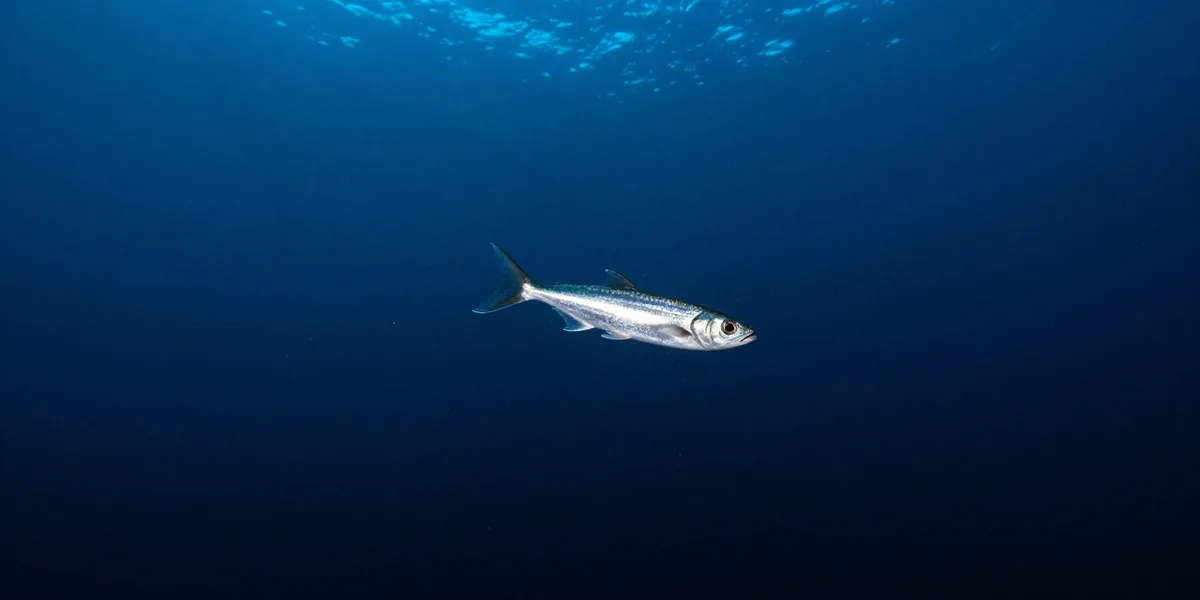
Blue light only, and not much of it. Bodies go silver, transparent, or counter-illuminated. This is where the ocean starts hiding from itself.
| Pressure | 21 – 101 atm |
|---|---|
| Light | 1 – 0.0001 % |
| Temp | 12 → 4 °C |
| Photosynthesis | No |
Almost entirely transparent apart from its eyes and gut, which it rotates to point downward so they cast the smallest possible shadow. Photophores beneath each eye erase what remains.
The most abundant vertebrate on Earth by biomass, and the reason ships' sonar found a false seafloor in 1942 — the whole layer rises at night and sinks again at dawn.
Deep red — effectively invisible where red wavelengths no longer reach. Avoids light so completely that a research lamp will drive an entire population downward for hours.
“Below two hundred metres the ocean stops being a place with weather and becomes a place with pressure. Nothing rusts down there in a hurry. Nothing hurries at all.”
— Dr. Imani Farrow, chief scientist, RV Thalassa
Zone 03 · 1,000–4,000 m
Bathypelagic
No sunlight at all — ever. The only photons are the ones animals make themselves, and roughly four in five of them do.
| Pressure | 101 – 401 atm |
|---|---|
| Light | 0 % solar |
| Temp | 4 °C, steady |
| Bioluminescence | ~80 % of species |
Females carry a lure colonised by luminous bacteria. Males are twenty times smaller, fuse to her flank, and dissolve into a permanent supply of sperm. Efficient, if grim.
Neither squid nor predator. It drifts in the oxygen minimum layer collecting marine snow on two sticky filaments, and when startled turns itself inside out into a spiked cape of light.
A mouth with a fish attached. Its jaw unhinges wider than its body so that a single rare meal, whatever the size, is never refused. A pink light on the tail tip does the advertising.
Zone 04 · 4,000–6,000 m
Abyssopelagic
Three quarters of the seafloor sits in this band. Food arrives as snow, or as a whale — and a whale keeps a community alive for fifty years.
| Pressure | 401 – 601 atm |
|---|---|
| Light | 0 % solar |
| Temp | 2 – 3 °C |
| Food input | Marine snow, falls |
Flaps a pair of ear-like fins to hover centimetres above the sediment. No ink sac — there is nothing to hide from in a place with no light, so the defence was abandoned entirely.
A woodlouse the length of a forearm, built by deep-sea gigantism and cold metabolism. One specimen in captivity refused food for five years and appeared entirely untroubled by it.
Zone 05 · 6,000–10,935 m
Hadopelagic
Named for Hades. Only the subduction trenches go this deep — narrow, isolated, and each one evolving its own residents in the dark.
| Pressure | 601 – 1,100 atm |
|---|---|
| Light | 0 % |
| Temp | 1 – 4 °C |
| Human visits | 27 recorded |
The deepest fish ever filmed, at 8,178 m. Its body is a translucent gel with an unfused skull; the chemical that keeps its proteins from collapsing runs out at about 8,200 m, which is why nothing lives below it.
“We put a lander at 10,900 metres and left it for four hours. It came back with amphipods, a plastic bag, and a temperature reading colder than a domestic fridge. Two of those three should not have been there.”
— Survey log, RV Thalassa, dive 214